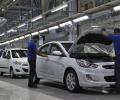
Automobile retail sales in India witnessed a double-digit year-on-year growth in February driven by robust sales across segments including passenger vehicles and two-wheelers, automobile dealers' body FADA said on Monday. Total registrations across segments rose 16 per cent year-on-year to 17,75,424 units last month, as compared to 15,31,196 vehicles in February 2022. Passenger vehicle retail sales rose 11 per cent to 287,182 units last month, against 258,736 units in the year-ago period.

Passenger vehicle dispatches from factories to dealers declined 13 per cent to the lowest level in five years in December last year as the industry continued to face production issues due to semiconductor shortage, auto industry body SIAM said on Friday. Passenger vehicle dispatches last month stood at 2,19,421 units compared to 2,52,998 units in December 2020. While acknowledging that the chip shortage situation is not expected to dramatically change in the short term, the industry body expressed hope that things will improve soon.

Automobile retail sales in India clocked best-ever performance last month aided by robust registrations across segments including passenger vehicles, two-wheelers and commercial vehicles, automobile dealer' body FADA said on Friday. The overall automobile retail sales rose by 26 per cent to 23,80,465 units last month, as compared with 18,93,647 units in November 2021. "November 2022 has clocked highest retails in the history of Indian automobile Industry with March'20 as an exception when retails were higher due to BS IV to BS VI transition," Federation of Automobile Dealers Associations (FADA) president Manish Raj Singhania said in a statement.
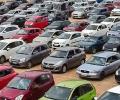
Automobile retail sales in India rose 14 per cent in January on the back of robust registrations across passenger vehicles, two-wheelers and tractors, dealers' body Federation of Automobile Dealers Associations said on Monday. Total sales across categories last month rose to 18,26,669 units, as compared to 16,08,505 units in January 2022. Passenger vehicle registrations rose to 340,220 units last month, an increase of 22 per cent as compared to 279,050 units in the year-ago period.

China's covid crisis could provoke a raw material crunch for India's EV industry later this year.
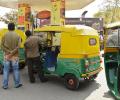
Amid a shift in mobility trends and people increasingly opting for less polluting energy sources, sales of compressed natural gas (CNG) vehicles increased more than 82 per cent in the past five years. A total of 729,902 CNG vehicles were sold in 2022-23 against 400,825 in 2017-18, according to VAHAN Dashboard. Though the increase in sales of CNG-powered vehicles has been significant, their share in overall vehicle sales remains minuscule as is the case with EVs.

Amidst healthy demand, there are apprehensions of possible hike in excise duty, and hence the player seeks excise duties to be retained at current levels

Days before Diwali, the monthly economic review by the finance ministry has highlighted moderation in urban demand, softening consumer sentiments and limited footfall as areas that need to be watched. In its review, released on Monday, the ministry also noted the early signs of artificial intelligence displacing workers, as described in anecdotal reports. The commentary from several large consumer goods companies, including Nestl India, Hindustan Unilever, and ITC, in their recent quarterly earnings, has been around a sluggish urban demand. Rural consumption, however, has mostly seen a revival, the companies pointed out.
Passenger vehicle retail sales in the country rose 40 per cent in June indicating an improvement in semiconductor supplies even as demand, especially for SUVs, remained robust, auto dealer' body FADA said on Tuesday. According to the Federation of Automobile Dealers Associations (FADA), passenger vehicle (PV) registrations rose to 2,60,683 units last month, as compared to 1,85,998 units in June 2021, registering an increase of 40 per cent. "The PV segment continued to see robust growth. An increase in dispatches clearly shows that semiconductor availability is now getting easier," FADA president Vinkesh Gulati said in a statement.

India appears poised to sustain its growth in a more durable way than before with the economy carrying the momentum from FY23 into the current fiscal year, the Annual Economic Review for 2022-23 released by the finance ministry on Thursday said. However, the report cautioned that escalation of geopolitical stress, enhanced volatility in global financial systems, sharp price correction in global stock markets, a high magnitude of El-Nino impact, and modest trade activity and FDI inflows, are factors that could constrain the pace of growth. "Should these developments deepen and dampen growth in the subsequent quarters, the external sector may challenge India's growth outlook for FY24," the finance ministry said.

Bajaj Auto expects to clock an over 50 per cent growth in exports to about 160,000 units during 2003-04, the company said on Thursday.
Retail sales of automobiles in India grew 8.31 per cent in August this year on the back of increase in registrations of vehicles across all major segments, automobile dealers' body FADA said on Thursday. As per data released by the Federation of Automobile Dealers Associations (FADA), total vehicle retail sales in the country stood at 15,21,490 units last month as compared to 14,04,704 units in August 2021. Passenger vehicles (PV) retail sales stood at 2,74,448 units as compared to 2,57,672 units in the year-ago month, a growth of 6.51 per cent.
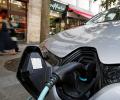
Society of Manufacturers of Electric Vehicle (SMEV) on Thursday said sales of EVs in India fell 20 per cent in the financial year 2020-21 to 236,802 units. In 2019-20 sales of electric vehicles (EVs), including electric two-wheelers (E2W), electric three-wheelers (E3W) and electric four-wheelers (E4W), stood at 295,683 units. For FY21, the E2W segment sales declined by 6 per cent to 143,837 units, as compared to 152,000 units in FY20, SMEV said in a statement, adding that the FY21 E2W sales included 40,836 high-speed and 103,000 low-speed E2W. The E3W segment registered sales of 88,378 units as against 140,683 units sold in FY20.

The five-year (2015-16 to 2020-21, or FY21) compound annual growth rate (CAGR) of the overall auto industry is now negative at 2 per cent, against 5.7-per cent growth it saw in the previous five years (from 2010-11 to 2015-16).
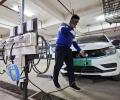
Even as the government debates whether to continue the FAME-II subsidy for electric vehicles (EVs), the share of such vehicles in overall sales is decelerating, after witnessing a heady growth in the first few years. The penetration of EVs - electric two-wheelers, passenger vehicles, three- wheelers and other segments collectively - in the first 10 months of FY24 has been pegged at 4.3 per cent, compared to 3.7 per cent in FY23, according to credit rating agency ICRA.

Passenger vehicle wholesales in India witnessed a decline of 41 per cent year-on year in September as automobile manufacturers struggled to produce adequate units owing to semiconductor shortage, auto industry body SIAM said on Thursday. Passenger vehicle sales last month stood at 1,60,070 units as compared with 2,72,027 units in the year-ago period. As per the latest data by Society of Indian Automobile Manufacturers (SIAM), two-wheeler dispatches to dealers also witnessed a dip of 17 per cent at 15,28,472 units, compared to 18,49,546 in September 2020.

Passenger vehicle wholesales in India slipped to a 10-year low in the April-December this fiscal, and the industry will have to work hard to regain better volumes and business health, industry body SIAM said on Thursday.

Domestic passenger vehicle wholesales rose by around 4 per cent year-on-year in November, driven by robust demand for utility vehicles, industry body SIAM said on Tuesday. Passenger vehicle dispatches from companies to dealers rose to 334,130 units last month, the best ever figure for the month of November, from 322,268 units in same month last year. Two-wheeler sales rose to 16,23,399 units last month, a growth of 31 per cent as compared to 12,36,282 units in November 2022.
Passenger vehicle dispatches to dealers in India rose over two-fold last month on a low base of Covid-19-hit May last year. As per the Society of Indian Automobile Manufacturers (SIAM), passenger vehicle wholesales rose to 2,51,052 units last month as compared to 88,045 units in May 2021. The two-wheeler sales rose to 12,53,187 units in May as compared to 354,824 units in the year-ago period.
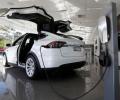
Sales of total electric vehicles in India are expected to be around 10 lakh units this year, equal to what was sold collectively in the last 15 years, mainly riding on the good traction witnessed by electric two-wheelers, Society of Manufacturers of Electric Vehicles (SMEV) said on Thursday. In 2021, the sales of electric two-wheelers (E2Ws) in the country jumped over two-fold at 233,971 units driven by a good traction of high-speed scooters as compared to 100,736 units in 2020, SMEV said in a statement. "We haven't seen better days than the last few months in the entire EV journey.

Aided by robust demand, automobile retail sales in India rose by 11 per cent last year as compared to 2022, dealers' body FADA said on Monday. The overall domestic automobile retail sales stood at 2,38,67,990 units in the 2023 calendar year as compared to 2,14,92,324 units in 2022. Passenger vehicle sales stood at 38,60,268 units last year, up 11 per cent from 34,89,953 units in 2022.

With nearly 100 launches and unveils, the Bharat Mobility Global Expo 2025, held in Delhi from January 17 to 22, made one thing clear to automobile enthusiasts: Electric vehicles (EVs) are the way ahead for the Indian auto market for years to come.

Amid better semiconductor chip supplies, the Indian automotive industry posted an 8 percent growth in production of vehicles across categories for the month of May, with three-wheelers (20 per cent) and passenger vehicles (16 per cent) leading the pack. Exports, however, dipped 21 per cent at an industry level. The industry also recorded its highest-ever May wholesales of domestic passenger vehicles (334,802 units), riding on high demand for sport utility vehicles (SUVs) and better supplies of semiconductor chips.

Vehicle prices have gone up as manufacturers gear up for the transition to stricter emission norm BS-VI from BS-IV beginning April 1.

Car deliveries during the nine-day period saw sharp year-on-year (double-digit increase for most automobile companies.

Truck movements across the India-Bangladesh border are on the rise, with increasing rentals signalling a trade recovery between the two South Asian nations. Yet, geopolitical tension looms large, with Bangladesh now under an interim government for nearly two months.
Scooters, once the fastest growing sub-segment, also declined for the second consecutive month in September.
Mahindra and Mahindra on Friday reported a 48 per cent rise in domestic vehicle sales in September on the back of good demand for utility vehicles and three-wheelers.

India is likely to grow by 7.5 per cent in the first quarter of the current financial year, driven by rising aggregate demand and non-food spending in the rural economy, according to an article in the RBI's May Bulletin released on Tuesday. The Indian economy has demonstrated marked resilience in the face of geopolitical headwinds impacting the supply chain, said an article on the state of the economy published in the May Bulletin.
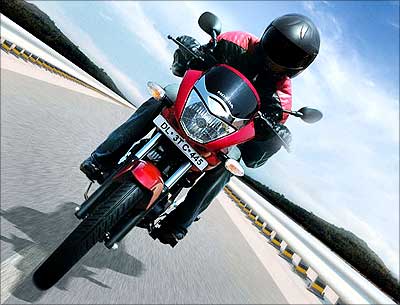
Two-wheeler firms' profits to slow down following a double-digit decline in sales.

Automobile dealers' body FADA on Tuesday expressed concern that the chip shortage issue could derail passenger vehicle (PV) retail sales during the festive season, as automakers are struggling with an adequate supply of vehicles to dealers due to production challenges. Terming semiconductor shortage as a "full-blown crisis", the industry body warned of a lacklustre festive season, especially for the passenger vehicle dealer fraternity, with low inventory levels and non-availability of the fast-moving model variants ahead of the peak festive period.

Plug-in hybrids have two engines and the electric part has a much larger battery than in the regular hybrids. Car companies, led by the Japanese, are pushing the Indian government to look at hybrids in the interim if it wants to reduce carbon emission.
286 dealers closed down in 18 months, 32,000 jobs impacted. Maharashtra leads with 84 closures, followed by Tamil Nadu and Delhi. The worst-hit is the passenger car segment.

Armed with necessary macro and micro growth drivers, India is on its way to becoming the fastest growing major economy in the world, a finance ministry report said. Rapid vaccination and teeming festivities will push India's ongoing recovery resulting in narrowing of demand-supply mismatches and greater employment opportunities, as per the monthly Economic Review prepared by the ministry.
The passenger vehicle dispatches to dealers increased by 11 per cent in July as improvement in semiconductor supplies helped the companies to ramp up production ahead of the festive season, auto dealers' body SIAM said on Friday. Overall passenger vehicle wholesales increased to 293,865 units last month compared to 264,442 units in July 2021. Passenger car dispatches rose 10 per cent to 143,522 units in July from 130,080 units in the year-ago period.
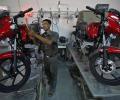
Bajaj Auto's market capitalisation (market cap) hit Rs 2 trillion mark for the first time. The stock of the two and three-wheeler major rallied 6 per cent to hit a new high of Rs 7,420 on the BSE in Tuesday's (January 9) intraday trade after its board approved Rs 4,000 crore share buyback at Rs 10,000 per share. The stock ended the day at Rs 7,093.75, up 1.55 per cent and its market cap a shade above Rs 2 trillion.
Mahindra and Mahindra has recorded a 23.6 per cent rise in automobile sales during December 2003 to 8,549 units from 6,916 units in the same month last year.
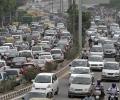
The BS-IV emission norms will come into force from April 1, 2017.
Bajaj Auto reported steady results in Q1FY25, with revenue surging 16 per cent year-on-year (Y-o-Y), operating profit registering a growth of 24 per cent Y-o-Y, and margins swelling 20.2 per cent. The profitability was aided by 50 basis points (bps) on the accrual of PLI benefits. The domestic prospects for two-wheelers are healthy, though the response to the newly launched CNG motorcycle is a key monitorable.

Large number of buyers has put purchases on hold because of a combination of factors, including high fuel prices, higher insurance cost, and firm interest rates.
